
The Ministry of External Affairs (MEA) has been allocated a total of Rs 18,050 crore in the Union Budget for 2023-24 which is an increase of around 4.64 per cent over last year's allocation of Rs 17,250 crore.

The Centre could further moderate its divestment target for 2024-25 (FY25), as it does not expect large receipts from asset sales - except some ongoing strategic ones, including IDBI Bank, which could spill over into next financial year. Also, it may drastically reduce its FY24 divestment target of Rs 51,000 crore. "We are still evaluating the Budget estimates for FY25. "New big-ticket asset sales are unlikely.

Finance Minister Nirmala Sitharaman on Thursday proposed to borrow Rs 14.13 lakh crore by issuing dated securities to meet revenue shortfall in the next financial year starting on April 1.

Defence exports grew 33 per cent in the calendar year 2023 (CY23) to around Rs 21,083 crore while domestic defence orders serviced by listed companies were Rs 48,000 crore. The sector is poised for steady growth. Budgeted domestic capex is likely to hit Rs 3 trillion per annum, and exports could reach $6 billion by FY29.

Roads, railways, and coal together are likely to account for 70 per cent of the government's takings from the upcoming second edition of the National Monetisation Pipeline (NMP), set to run from FY26 to FY30. In comparison, these three sectors are estimated to have contributed 66 per cent in the first edition of the NMP - FY22 to FY25.

'If the BJP detoxifies the nuclear liability law, it will bring economic, environmental and, most of all, strategic benefits.' 'Let's keep our fingers crossed and hope that this Budget promise is met soon -- ideally, before Mr Modi heads to his first meeting with Trump 2.0,' observes Shekhar Gupta.

The Union government's finances witnessed significant improvement in August after a stressful first four months of the current fiscal year. India's gross tax revenue, comprising both direct and indirect taxes, for the first five months of 2023-24 surged 16.5 per cent year-on-year (Y-o-Y) to Rs 11.8 trillion. During the April-July period, gross tax revenue increased by a mere 2.8 per cent compared to the Budget Estimate of 12.1 per cent growth for FY24.

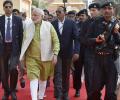
In the Union Budget for 2021-22 presented by Finance Minister Nirmala Sitharaman on Monday, the force received Rs 429.05 crore, an increase of Rs 2.78 crore (or 0.65 per cent hike) from the last budget.

The government also announced that healthcare cover under the Ayushman Bharat insurance scheme will be extended to all ASHA and anganwadi workers and helpers.

Your ultimate guide to helicopter rides in India this Valentine's Day

Finance Minister Nirmala Sitharaman presents her fourth Budget in Lok Sabha on Tuesday.

Ecommerce firm Amazon has infused ~1,600 crore into its India entity Amazon Seller Services, according to its regulatory filings. The funding comes at a time when the company is seeing opportunities in emerging geographies, including India. The regulatory filings are dated April 15. This is the second time in five months that Amazon invested in its India arm Amazon Seller Services. Before this, Amazon had infused over ~1,000 crore into its Indian entity this year.

The shortfall in GST compensation payable to states in the current fiscal is estimated at Rs 2.69 lakh crore, of which Rs 1.58 lakh crore would have to be borrowed this year. The Centre expects to collect over Rs 1.11 lakh crore through cess on luxury, demerit and sin goods which will be given to the states to compensate them for the shortfall in revenue arising out of GST implementation. The remaining Rs 1.58 lakh crore would have to be borrowed to meet the promised compensation to states under the Goods and Services Tax (GST) regime.

'The numbers are null and void now. Look, we can give out projections now, but we know that a week later those numbers will also be irrelevant. So we need to wait,' a top government official said.

Gold, a safe-haven bet, is likely to continue its record-smashing journey in the New Year, rising to Rs 85,000 per 10 grams and even Rs 90,000 level in domestic markets if geopolitical tensions and global economic uncertainties continue.

Fiscal deficit would be brought down to below 4.5 per cent by 2025-26, Finance Minister Nirmala Sitharaman said on Wednesday. She also said that tax receipts for the next fiscal are budgeted at Rs 23.3 lakh crore and states would be allowed 3.5 per cent of GDP as fiscal deficit. To finance the fiscal deficit in 2023-24, net market borrowing from dated securities is estimated at Rs 11.8 lakh crore, Sitharaman said while presenting the Union Budget for 2023-24 in the Lok Sabha.
Banking on increased freight haul and earnings from upper class travellers, Indian Railways has projected a gross earning of Rs 43,445 crore (Rs 434.45 billion) in 2003-04.

Wedding planner WedMeGood estimates that the average wedding budget has surged to Rs 36.5 lakh this year, with destination weddings averaging Rs 51 lakh.

'Market feels this Budget will promote all-round growth and that is what is giving it confidence.'

'The estimated expenditure is expected to be more than double the Rs 60,000 crore spent in 2019'

Direct tax collection, including personal income tax, rose by 35.46 per cent to Rs 6.48 lakh crore in the current fiscal up to September 8, reflecting an uptick in the economy. The country recorded a GDP growth of 13.5 per cent during the first quarter ended on June 30, 2022. Direct tax collection, net of refunds, stands at Rs 5.29 lakh crore which is 30.17 per cent higher than the net collections for the corresponding period of last year, according to the data released by the Income Tax Department.

With the first quarter gross tax mop-up reaching Rs 5.6 lakh crore, Icra Ratings on Friday said the government is set to exceed the budgeted tax collection target of Rs 22.2 lakh crore for 2021-22, led by indirect taxes. The government has budgeted a modest 9.5 per cent growth in tax collections at Rs 22.2 lakh crore for FY22, over FY21 collections of Rs 20.2 lakh crore. However, despite the second wave of the pandemic, the April-June quarter tax collections rose to Rs 5.6 lakh crore, which is 39 per cent higher than Q1 of FY20.

The Union government is projected to share about 32 per cent of central taxes with states during the financial year 2024-25 against the 15th Finance Commission's recommendation of 41 per cent. The Revised Estimates (RE) for FY24, too, show a similar share of states in the central taxes at 32 per cent. In absolute terms, however, there has been an increase in the amount devolved to states compared to the Budget Estimates (BE) for FY24 at Rs 11 trillion.

The USTR report, released just ahead of the US' April 2 deadline for implementing reciprocal tariffs, has also cited high tariffs and price caps, which have not increased in line with inflation, as key obstacles for US businesses.
The net direct tax collection so far this fiscal rose 19.41 per cent to Rs 14.70 lakh crore, reaching about 81 per cent of the full-year target, the income tax department said on Thursday. "The provisional figures of Direct Tax collections up to January 10, 2024, continue to register steady growth," the Central Board of Direct Taxes (CBDT) said in a statement. Direct Tax collection, net of refunds, stood at Rs 14.70 lakh crore which is 19.41 per cent higher than the net collection for the corresponding period of last year.

'Spend, but create assets, spend but make sure that people benefit from it.' 'This has been a beautiful guiding principle. And I think as a finance minister I owe so much to the prime minister for keeping this path clear before us.'

The Budget outlay for health and well being is Rs 2.23 lakh crore in 2021-22 as against BE of Rs 94,452 crore and marks an increase of 137 per cent," she said while presenting 2021-22 Budget in the Lok Sabha.

The new government that presents the full Budget for 2024-2025 in July should be ready to restructure the way divestment is managed and implemented, proposes A K Bhattacharya.
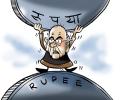
While the finance minister had a great opportunity to come out with flying colours while presenting this last Budget of his government, he didn't, says Omkar Goswami.

Excluding the pension outgo, the allocation in the Union Budget for the armed forces stands at Rs 3.62 lakh crore.

The number of centrally sponsored schemes have increased to 35 in FY22 from 30 in FY21 and central sector schemes have increased to 704 from 685 in the previous year, reports Dilasha Seth.
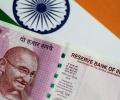
In November, the fiscal deficit widened by Rs 2.2 trillion, the highest ever in any month this financial year.

The Uttar Pradesh government is expecting over 35 crore pilgrims to attend the Maha Kumbh Mela in Prayagraj, a significant increase from the 24 crore who attended the 2019 Kumbh Mela. The event, which will take place over 45 days, will feature extensive security and sanitation measures, as well as a digital component. The state government has allocated Rs 7,000 crore for the event.

'We are getting to understand the mind of this generation.' 'Minor tweaks are being made to ease the process as we go along.'

Of the Rs 1.97 trillion that the government intends to spend on all 14 production-linked incentive (PLI) schemes, around Rs 41,000 crore remains unutilised as of now, according to a senior government official. This means that 80 per cent of the total allocated amount, or Rs 1.56 trillion, will be used to pay incentives to companies eligible to claim benefits over the next few years. The unutilised amount/savings result from undersubscription, lukewarm responses in the case of schemes such as textile, as well as a reduction in the allocation of schemes.
Direct tax collection, net of refunds, moderately exceeded the revised estimates (RE) for the financial year 2023-24 (FY24) on the back of personal income tax revenues, but corporation tax receipts fell short of the RE. Net direct tax collection stood at Rs 19.58 trillion in FY24, surpassing the RE of Rs 19.45 trillion by Rs 13,000 crore, or 0.7 per cent. The government had revised up FY24 projections for personal income tax by 13.5 per cent over the Budget estimates (BE) of Rs 9 trillion, at Rs 10.22 trillion.

However, finding the funds to fulfill them will be a herculean task.

Schemes like the Mukhyamantri Majhi Ladki Bahin Yojana strain fiscal resources amid rising unemployment and prices of food items.

'The bull market cycle ran for five years. It's the end of that cycle.' 'The next cycle is a down cycle, and in that down cycle, you will see the Sensex falling from their highs of around 68,000 to maybe 40,000-50,000 at the bottom of the cycle.'
 © 2026 Rediff.com - Advertise with us - Disclaimer - Privacy Policy - Sitemap - Feedback - About us - Terms of use - Grievances